A case study is an in-depth analysis of one specific situation, such as an organization, a patient, an event or a legal dispute, that applies theory and evidence to explain what happened and to recommend action or draw conclusions. It is set in business, nursing and health, psychology, law, education and many other subjects, and the marks usually go to analysis rather than description. Students who retell the case lose them. This guide covers eight steps, from reading the case to revising your draft, with a structure table, a framework guide and a worked nursing example.
Quick outline
- Introduction: the case, the central problem and your approach
- Case background: only the facts the analysis needs
- Analysis: theory or a framework applied to those facts
- Solutions or recommendations: options, a justified choice and next steps
- Conclusion: the answer to the problem and its significance
📋 Table of Contents
- What Is a Case Study?
- Step 1: Read the Brief and the Case
- Step 2: Define the Central Problem
- Step 3: Choose a Framework
- Step 4: Gather Evidence
- Step 5: Plan Your Structure
- Step 6: Write the Analysis
- Step 7: Recommend Solutions
- Step 8: Revise and Reference
- Worked Example: A Nursing Case Study
- Common Mistakes to Avoid
- Case Study Checklist
- FAQs
What Is a Case Study?
A case study examines a single case closely, whether that is one company, one patient, one court decision, one classroom or one community, and uses it to show how theory works in practice. The goal is understanding: why did this happen, what does it mean and what should be done?
The term covers two related things, so check which one your course means:
- A case study assignment. You are given a case, or choose one, and analyze it using course theory. This is the common coursework task.
- A case study as a research method. You collect and analyze evidence about a case yourself, often through interviews, documents and observation. Researchers such as Robert Yin and Robert Stake wrote the best-known guides to this approach.
What you analyze, and how, depends on the subject:
| Subject | What the case usually is | Typical analysis |
|---|---|---|
| Business | A company facing a decision or problem | Frameworks such as SWOT, PESTLE or Porter's Five Forces, then recommendations |
| Nursing and health | A de-identified patient or care situation | The nursing process (assessment, diagnosis, planning, implementation, evaluation) linked to evidence |
| Psychology and social sciences | An individual, group or community | Theory-driven interpretation of the evidence, sometimes with a formal research design |
| Law | A dispute or decided case | Issue, rule, application, conclusion (IRAC) |
A case study is not the same as an essay. For the difference in how each is built, see our guides to essay outline and structure and argumentative essays.
Step 1: Read the Brief and the Case
Read the assignment brief before the case, so you know what you are looking for. Note the word count, the required sections, the marking criteria and whether you must use a named framework or specific readings.
Then read the case twice. On the first pass, read for the story. On the second, highlight facts that bear on the question, such as numbers, dates, decisions, stakeholders and constraints. Note anything the case leaves out, because missing information often matters, and you may need to state assumptions.
Step 2: Define the Central Problem
Every strong case study analysis is built around one central problem or question. Write it as a single sentence before you do anything else:
[Case] faces [problem] because [main cause], which affects [who or what].
Separate symptoms from causes. Falling sales, high staff turnover or a patient's repeated readmission are symptoms. The analysis should uncover the underlying cause, and the recommendation should address that cause rather than the symptom. If you find several problems, rank them and focus on the one or two that matter most within your word count.
Step 3: Choose a Framework
A framework gives your analysis a structure and shows the marker you can apply theory. Choose the one that fits the problem, not the one you know best:
| Framework | What it examines | Best for |
|---|---|---|
| SWOT | Strengths and weaknesses (internal), opportunities and threats (external) | Overall position of an organization |
| PESTLE | Political, economic, social, technological, legal and environmental factors | The external environment |
| Porter's Five Forces | Competitive rivalry, new entrants, substitutes, and supplier and buyer power | Industry competition |
| Nursing process | Assessment, diagnosis, planning, implementation, evaluation | Patient or care cases |
| IRAC | Issue, rule, application, conclusion | Legal cases |
Your course may require a particular model, so check your brief and reading list first. A framework is a tool for organizing evidence, not a substitute for analysis. A SWOT grid with no explanation earns few marks.
Step 4: Gather Evidence
You need two kinds of evidence:
- Case evidence: the facts, figures and quotations in the case itself. Cite the case when you use them.
- Scholarly evidence: theory, research and industry or clinical sources that explain the case and support your recommendations.
Prefer peer-reviewed articles, textbooks and authoritative reports, and judge each source by its author, publisher, date and method. Our guide to finding credible academic sources covers this in detail. Record each full reference as you read, in the style your course requires, such as Harvard or APA.
Confidentiality: if your case involves a real patient, client or organization, follow your course and professional rules on anonymity. Remove names, exact dates, locations and any detail that could identify them, and do not use confidential material you were not given permission to use.
Step 5: Plan Your Structure
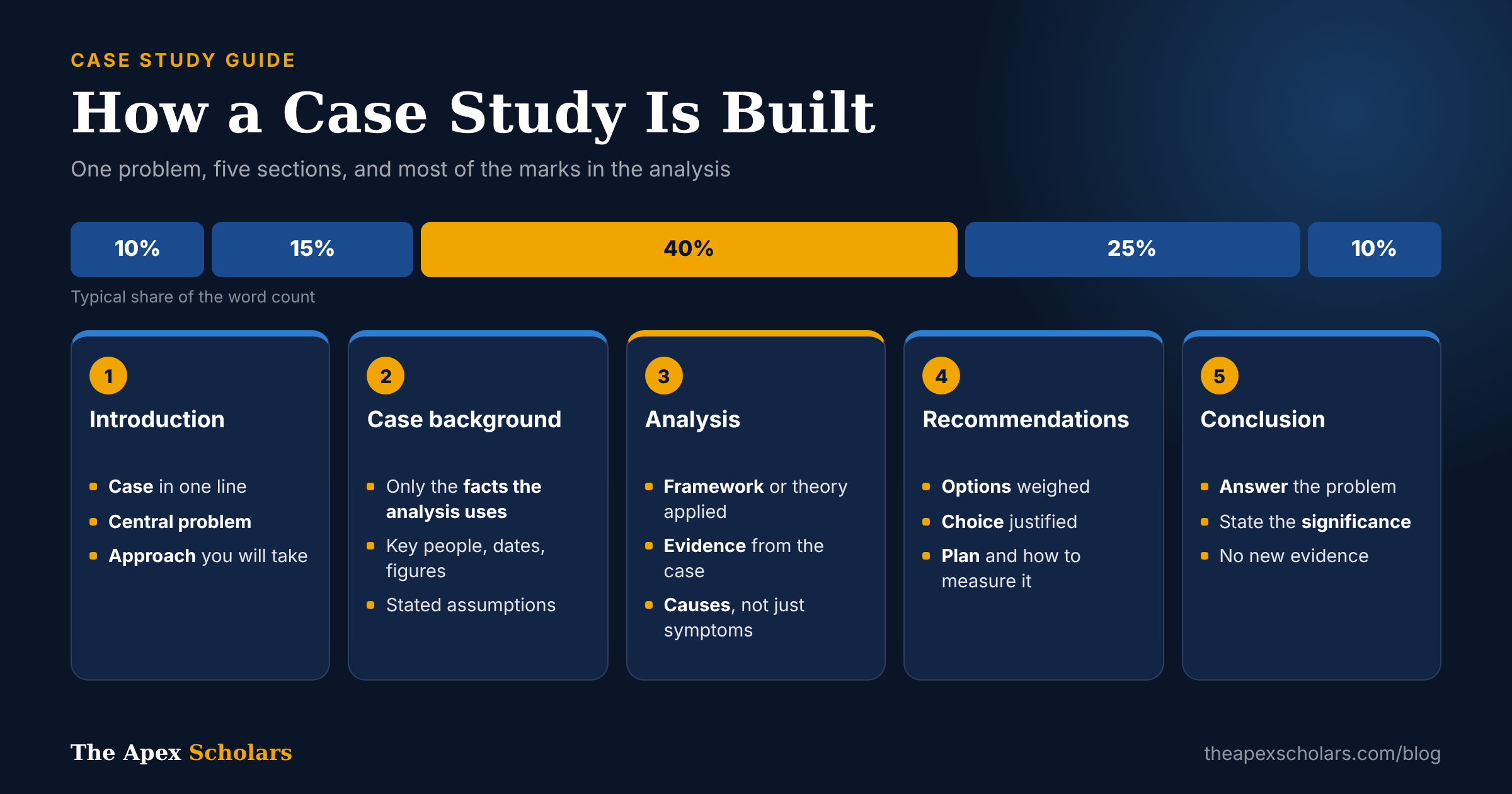
If your brief does not set the sections, this structure works for most coursework. The word counts show a 2,000-word example, and you can scale the percentages to your own limit:
| Section | Share | Example at 2,000 words | What it does |
|---|---|---|---|
| Introduction | About 10% | About 200 | Introduce the case, state the central problem and outline your approach |
| Case background | About 15% | About 300 | Summarize only the facts the analysis uses |
| Analysis | About 40% | About 800 | Apply theory or a framework and explain the causes of the problem |
| Solutions or recommendations | About 25% | About 500 | Weigh the options, justify your choice and say how to implement it |
| Conclusion | About 10% | About 200 | Answer the problem and state the significance |
These shares are a typical pattern, not a rule, and the title page and reference list usually sit outside the word count. Some courses ask for different sections, such as a separate literature review or an executive summary, so follow your brief.
📌 Stuck on a case study analysis? Our expert writers can help → — case studies across all subjects, properly referenced.
Step 6: Write the Analysis
The analysis is where most marks are won. Build each paragraph in four moves:
- Point: state one finding or cause.
- Evidence: support it with a fact from the case.
- Theory: link it to a framework, concept or study, cited.
- Meaning: explain what it shows about the central problem.
Describe less and explain more. The case background should be short because the marker has already read the case. Use it to set up the analysis, then spend your words on why things happened and what follows.
Step 7: Recommend Solutions
Recommendations must follow from your analysis. A reliable pattern:
- Set out two or three realistic options.
- Weigh each one against clear criteria, such as cost, feasibility, risk and impact, and use evidence.
- Choose one and justify it. Explain why it addresses the underlying cause.
- Say how to implement it, including who acts, in what order and how you would measure success.
- Acknowledge limits and risks, and any assumptions you made because the case was incomplete.
Some health and social science case studies ask for interpretation or evaluation instead of recommendations, so check what your brief wants.
Step 8: Revise and Reference
Leave at least a day between drafting and revising if you can. Check that every section serves the central problem, that each claim has evidence, and that your recommendations answer the cause you identified. Then check your citations and reference list against your style guide, and proofread (see our guide to proofreading your essay).
Worked Example: A Nursing Case Study
This example is fictional and illustrative, and the patient is anonymized. Replace the bracketed evidence with real, cited sources from your own research, and follow your course's rules on anonymity for any real case.
Case: Mr A, a 72-year-old man on day two after hip fracture surgery. He is in pain when he moves, spends most of the day in bed, is eating little, and the nurse notices a patch of reddened skin over his sacrum that does not fade when pressed.
Central problem: Mr A is at high risk of developing a pressure injury, and may already have an early one, because reduced mobility, poor nutritional intake and pain are combining to keep pressure on vulnerable skin.
Framework chosen: the nursing process, with a validated risk tool (the Braden Scale, where a lower score means higher risk) to support the assessment.
| Stage | What the analysis covers for Mr A |
|---|---|
| Assessment | Mobility, nutrition, skin condition, pain and moisture; a Braden Scale score; the sacral skin change |
| Diagnosis | Risk of impaired skin integrity, with a possible early pressure injury over the sacrum |
| Planning | Goals such as no deterioration of the sacral skin and improved intake, agreed with Mr A and the care team |
| Implementation | Repositioning, a suitable support surface, regular skin inspection, pain relief before movement and a dietitian referral |
| Evaluation | Skin checks, repeat risk assessment, intake and pain, with the plan revised if the skin worsens |
Sample analysis paragraph
Mr A's immobility and poor intake place him at high risk of pressure injury, and the early sacral change suggests tissue damage may already have started. [Evidence: cite the case facts on mobility, intake and skin findings, and a current clinical guideline on pressure injury prevention.] Sustained pressure on skin over a bony area reduces blood supply to the tissue, and undernutrition makes that tissue less able to recover. Pain adds a third factor, because he moves less to avoid it. This means pain relief before repositioning is part of prevention, not a separate task, and it explains why a plan built on repositioning alone would probably fail.
Recommendation: start a prevention plan that combines repositioning, a pressure-redistributing surface and regular skin checks with pain relief before movement and a nutrition referral, and reassess him against the Braden Scale and the sacral skin at set intervals set by local policy.
Notice the pattern: the paragraph states a finding, supports it with case evidence and theory, and explains what it means for the central problem. The same pattern works for a business, psychology or law case with a different framework.
Common Case Study Mistakes to Avoid
- Retelling the case. If a paragraph only describes, ask what it explains.
- Treating symptoms as the problem. Falling sales is a symptom. Find the cause.
- A framework with no analysis. A filled-in SWOT grid is not an argument.
- Recommendations that do not follow from the analysis. Each one should answer a cause you identified.
- Unrealistic solutions. Ignoring cost, time or constraints in the case makes advice unusable.
- Unsupported claims. Back each point with case facts or scholarly sources.
- Ignoring the brief. Missing a required section or framework costs marks.
- Breaking confidentiality. Never include identifiable patient or client details.
Case Study Checklist
- ☐ The central problem is stated in one clear sentence
- ☐ The case background includes only facts the analysis uses
- ☐ A suitable framework or theory is applied and explained
- ☐ Each analysis paragraph links evidence, theory and meaning
- ☐ Recommendations are realistic, justified and follow from the analysis
- ☐ Assumptions and limitations are stated
- ☐ Any real people or organizations are anonymized as required
- ☐ All sources are cited and the reference list matches the in-text citations
- ☐ The word count and required sections match the brief
FAQs
How long should a case study be?
It depends on your brief. Coursework case studies commonly run 1,500 to 3,000 words, while a case study used as a research method can be much longer. Follow the stated word count and ask your tutor if none is given.
What is the difference between a case study and an essay?
An essay builds an argument about a question. A case study analyzes one specific situation, such as an organization, patient, event or legal dispute, and applies theory to explain it and recommend action or draw conclusions.
Do I need academic sources in a case study?
Usually yes. The case facts give you the situation, but scholarly sources supply the theory, frameworks and evidence you use to analyze it. Check your brief for the number and type of sources required.
Can I use SWOT or another framework?
Yes, if it fits the problem and your brief allows it. A framework organizes your analysis, but it is not the analysis itself. Always explain what each finding means for the case.
How do I start a case study?
Read the case twice, write the central problem in one sentence, and list the key facts. Then choose the framework or theory that best explains the problem before you begin drafting.
Should I use first person in a case study?
That varies by discipline and tutor. Many courses prefer an impersonal style, though reflective and practice-based case studies often allow first person. Check your marking criteria.
🔎 Writing in a specific subject? Read our guides to the nursing essay, the business essay and the law essay.
Need Help With a Case Study?
Our expert writers help students with case studies, analyses and coursework — delivered on time, every time, worldwide.
Get Academic Help →