An argumentative essay takes a clear, debatable position and defends it with evidence, reasoning and a fair response to the strongest opposing view. It is one of the most common university assignments, and a frequent place to lose marks: students describe a topic instead of arguing a claim. Strong argumentative essays share one skeleton: an arguable thesis, body paragraphs built on evidence, and an honest rebuttal of the other side. This guide covers eight steps, from choosing a topic to writing the conclusion, plus a worked example you can adapt to your own question.
Quick outline
- Introduction: hook, context, thesis
- Body paragraphs 1 to 3: one reason each, built as claim, evidence, analysis, link
- Counterargument: state the strongest opposing view fairly, concede what is valid, rebut it
- Conclusion: restate the thesis, summarize your reasons, state the significance
📋 Table of Contents
- What Is an Argumentative Essay?
- Step 1: Choose a Debatable Topic
- Step 2: Research and Gather Evidence
- Step 3: Write an Arguable Thesis
- Step 4: Plan Your Structure
- Steps 5 and 6: Write the Introduction and Body Paragraphs
- Step 7: Address the Counterargument
- Step 8: Write the Conclusion
- Worked Example
- Common Mistakes to Avoid
- Revision and Proofreading Checklist
- FAQs
What Is an Argumentative Essay?
An argumentative essay asks you to take a side on a debatable issue and prove it is the more reasonable one. Every part of the essay serves that claim: the thesis states it, the body paragraphs support it, and the counterargument shows you have tested it against the best opposition.
It is often confused with two neighboring essay types:
| Essay type | Goal | Relies on | Opposing views |
|---|---|---|---|
| Argumentative | Prove a claim is the most reasonable position | Evidence and logical reasoning | Engaged and rebutted |
| Persuasive | Move the reader to agree or act | Evidence plus appeals to emotion and audience | Often mentioned briefly |
| Expository | Explain a topic neutrally | Facts and explanation | No position taken |
Some courses use "argumentative" and "persuasive" interchangeably, so follow the wording of your assignment brief.
Step 1: Choose a Debatable Topic
A topic is debatable when reasonable, informed people could disagree about it. A quick test: if nobody could sensibly answer "I disagree", you have a fact or a platitude, not an argument.
| Weak topic | Why it fails | Stronger, debatable version |
|---|---|---|
| Many students use social media | A fact, not a claim | Universities should ban phones and laptops from lectures |
| Climate change | Far too broad | Governments should tax carbon rather than subsidize renewable energy |
| Plagiarism is wrong | Nobody disputes it | Universities should replace take-home essays with supervised writing because of AI tools |
When you choose:
- Check the brief first. Some assignments give you the question; others limit the subject area.
- Narrow it. A focused claim is easier to prove in 1,500 words than a sweeping one.
- Pick a side you can support with evidence. You do not have to hold the view personally. Tutors mark the quality of your reasoning, not your opinion.
Step 2: Research and Gather Evidence
Research before you commit to a final thesis. The evidence you can actually find should shape your claim, not the other way round.
Strong argumentative essays draw on a mix of evidence:
- Data and statistics from official or peer-reviewed sources
- Published studies and systematic reviews
- Expert analysis from recognized scholars in the field
- Case examples, historical or contemporary
- Policy, legal or institutional documents, where relevant
Start with your library databases and Google Scholar, then judge each source by its author, publisher, date and method. Our guide to finding credible academic sources covers this in detail.
Two habits save time later:
- Record the full reference as you read, in the style your course requires, such as Harvard or APA.
- Collect evidence against your position too. Understanding the best opposing case now gives you the material for your rebuttal in Step 7.
Step 3: Write an Arguable Thesis
Your thesis is the one or two sentences that state your position and, ideally, preview your main reasons. Everything else in the essay exists to prove it.
A simple formula:
[Subject] should / must / is [position], because [reason 1], [reason 2] and [reason 3].
A strong thesis passes four checks. It takes a position someone could dispute, it is specific, it can be proved with evidence, and it answers the question you were set.
| Weak thesis | Stronger thesis |
|---|---|
| This essay will discuss carbon taxes. | Governments should tax carbon rather than subsidize renewables, because a tax prices emissions directly, raises public revenue and lets markets find the cheapest reductions. |
| AI tools are affecting university assessment. | Universities should assess writing in supervised settings, because AI tools weaken take-home essays as evidence of individual learning and supervised formats test skills more directly. |
Place the thesis at the end of your introduction. Some courses expect a signposting sentence such as "This essay argues that...", while others discourage it, so check your marking criteria.
Step 4: Plan Your Structure
Choose a structure before you draft. Three models are common in academic writing:
| Model | How it works | Best for |
|---|---|---|
| Classical | Introduction, reasons with evidence, counterargument and rebuttal, conclusion | Most undergraduate essays |
| Toulmin | Claim, grounds (evidence), warrant (why the evidence supports the claim), backing, qualifier, rebuttal | Complex topics where the logic needs to be spelled out |
| Rogerian | Fairly state the opposing view, find common ground, then present your position | Polarized topics or skeptical readers |
The Toulmin model is named after the philosopher Stephen Toulmin, and the Rogerian approach draws on the psychologist Carl Rogers' emphasis on understanding the other side before responding.
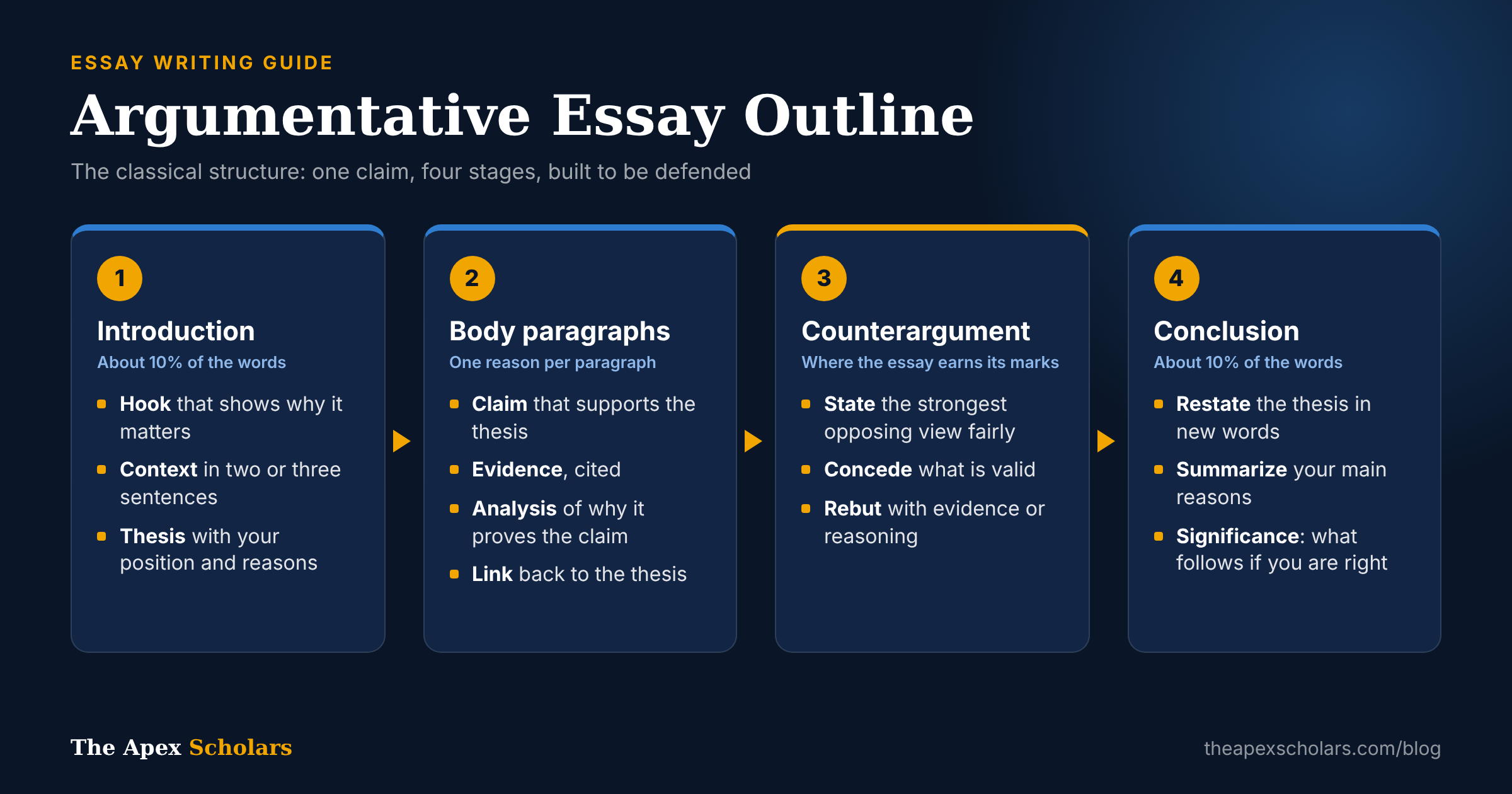
If your brief does not specify a model, use the classical structure:
- Introduction: hook, context, thesis
- Body paragraph 1: your first reason, with evidence and analysis
- Body paragraph 2: your second reason
- Body paragraph 3: your third reason
- Counterargument and rebuttal: the strongest opposing view, and why your position still holds
- Conclusion: restated thesis, key reasons, significance
Many writers put their strongest reason last to build momentum, while others lead with it. Either works if the order is deliberate.
📌 Stuck on a thesis or an outline? Our expert writers can help → — argumentative essays across all subjects.
Steps 5 and 6: Write the Introduction and Body Paragraphs
Step 5: The introduction
A strong introduction does three jobs in roughly this order:
- Hook: a surprising fact, a pointed question or a short example that shows why the issue matters.
- Context: two or three sentences of background so the reader understands the debate.
- Thesis: your position, stated clearly.
Avoid dictionary definitions and sweeping openers such as "Since the beginning of time...". As a rule of thumb, keep the introduction to about a tenth of the total word count.
Step 6: The body paragraphs
Give each body paragraph one claim and build it in four moves:
- Claim: a topic sentence stating the reason, linked to your thesis.
- Evidence: a statistic, study, quotation or example, properly cited.
- Analysis: an explanation of how the evidence supports your claim. This is where most marks are won.
- Link: a closing sentence tying the paragraph back to the thesis or leading into the next point.
The most common weakness is evidence without analysis: a quotation or statistic dropped in and left to speak for itself. Always tell the reader what it proves. When you paraphrase sources, our guide to paraphrasing without plagiarising shows how to do it correctly.
Step 7: Address the Counterargument
A counterargument shows you have tested your position against the best opposition, which is what separates an argumentative essay from an opinion piece. Handle it in three moves:
- State the strongest opposing argument fairly. Pick the version a thoughtful critic would actually make, not a weak one that is easy to knock down.
- Concede what is valid. Acknowledging a real strength in the other side builds credibility.
- Rebut with evidence or reasoning. Show why your position still holds, for example because the objection has limited scope, rests on weaker evidence, or can be answered by a trade-off.
A useful sentence pattern: "Critics argue that... This concern has merit because... However, ..."
Place the counterargument after your main reasons, so the reader has already seen your best case. In a Rogerian essay it comes first.
Step 8: Write the Conclusion
The conclusion should leave the reader convinced that your position holds. Include three things:
- Your thesis, restated in fresh words. Do not copy the original sentence.
- A one- or two-sentence summary of your main reasons.
- The significance: what follows if your argument is right, such as a recommendation, an implication or a question for further research.
Do not introduce new evidence, and do not weaken your case with phrases like "I may be wrong, but...". As with the introduction, about a tenth of the word count is a sensible target.
Worked Example
This example is illustrative. Replace the bracketed evidence with real, cited sources from your own research.
Question: Should universities replace take-home essays with supervised writing?
Thesis: Universities should assess writing in supervised settings, because AI tools weaken take-home essays as evidence of individual learning, supervised formats test skills more directly, and the change protects students who do their own work.
Outline
- Introduction: hook about how quickly AI writing tools have spread, brief context on assessment, thesis
- Reason 1: take-home essays no longer reliably show what a student can do alone
- Reason 2: supervised writing tests skills such as planning, argument and editing under real conditions
- Reason 3: supervised assessment is fairer to students who do their own work
- Counterargument: timed writing may disadvantage anxious or slower writers, answered with extra time, accommodations and allowing planning notes
- Conclusion: restated thesis, summary of the three reasons, implication for assessment design
Sample body paragraph (Reason 1)
Supervised writing gives markers more reliable evidence of what a student can do independently. [Evidence: cite a study or institutional report on how common generative AI use is in unsupervised assessment.] If a meaningful share of take-home submissions are partly or wholly machine-generated, a grade on those essays no longer measures the writer's own skill. In-class writing removes that uncertainty, so the mark reflects the student rather than the tool. This supports the central claim that supervised formats provide better evidence of individual learning, and it leads directly to the question of which skills those formats can test.
🔎 See it in full. Read a complete argumentative essay with real sources and an APA 7 reference list: Should Safe Nurse Staffing Ratios Be Mandated by Law?
Common Argumentative Essay Mistakes to Avoid
- Arguing a fact or an obvious claim. If no one could disagree, there is nothing to argue.
- A vague thesis. "Social media has advantages and disadvantages" takes no position.
- Evidence without analysis. Dropping in a quotation or statistic and moving on.
- A straw-man counterargument. Rebutting a weak version of the opposing view proves nothing.
- Logical fallacies. Common ones include attacking the person instead of the argument, the slippery slope, the false dilemma and the hasty generalization.
- Weak or unsourced evidence. Anonymous blogs and unsupported claims undermine an otherwise good argument.
- New arguments in the conclusion. Save them for the body or leave them out.
- Summary instead of argument. If a paragraph only describes, ask what it is proving.
Revision and Proofreading Checklist
Leave at least a day between drafting and revising if you can. Then check:
- ☐ The thesis takes a clear, debatable position
- ☐ Every body paragraph opens with a claim that supports the thesis
- ☐ Each piece of evidence is followed by analysis
- ☐ The strongest opposing view is stated fairly and rebutted
- ☐ The conclusion restates the thesis in new words and adds no new evidence
- ☐ All sources are cited in the required style, and the reference list matches the in-text citations
- ☐ The word count meets the brief
- ☐ Grammar, spelling and punctuation are proofread (see our guide to proofreading your essay)
FAQs
How long should an argumentative essay be?
It depends on your brief. Undergraduate essays are commonly 1,500 to 2,500 words, and shorter school-level essays can run 500 to 1,000. Follow the stated word count, and ask your tutor if none is given.
Can I use "I" in an argumentative essay?
That varies by discipline and tutor. Some allow limited first person for your stance ("I argue that..."), while others prefer an impersonal style ("This essay argues..."). Check your marking criteria or a model answer.
How many sources do I need?
Your brief or module handbook usually sets this. If it does not, ask your tutor. Source quality matters more than quantity, so prefer peer-reviewed and authoritative sources.
Do I have to include a counterargument?
In academic writing, almost always. Engaging fairly with opposing views is what makes the essay an argument rather than an opinion.
Can I argue a position I disagree with?
Yes. Tutors assess the quality of your reasoning and evidence, not whether they share your view.
Where does the thesis go?
Usually at the end of the introduction, so the reader knows your position before the evidence begins.
🔎 Writing a related essay type? Read our guides to the critical analysis essay and the first-class essay.
Need Help With an Argumentative Essay?
Our expert writers help students with essays, analyses and coursework — delivered on time, every time, worldwide.
Get Academic Help →