A well-structured essay has an introduction that states your answer, body paragraphs that each prove one point with evidence, and a conclusion that pulls the argument together. This guide takes you from assignment question to finished essay: how to read the question, build an outline, structure each section, and format the final draft in APA, MLA, Chicago or Harvard. It includes a word-count guide and an outline you can adapt to any topic.
Quick outline
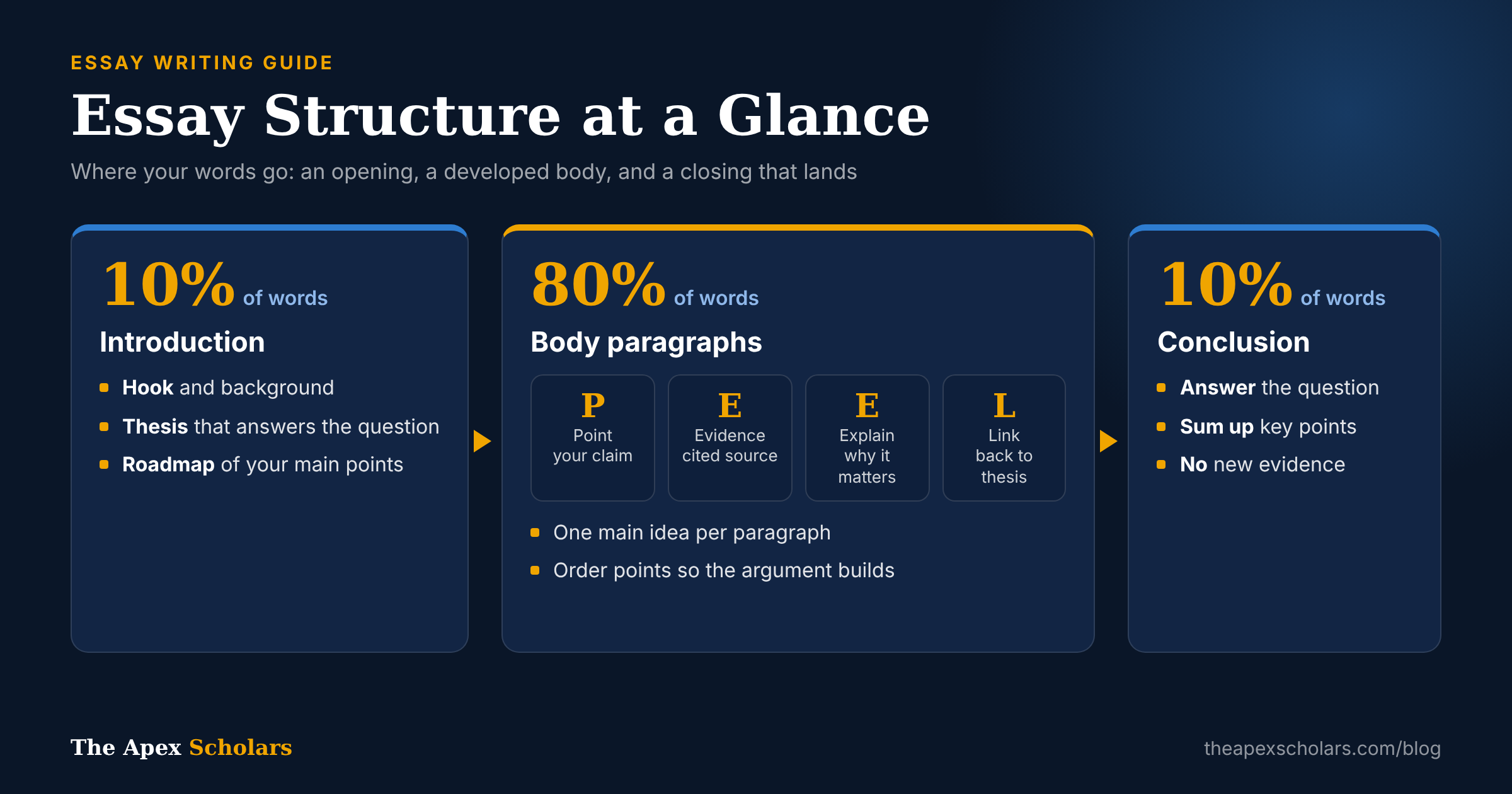
- Introduction (about 10% of the words): context, thesis, and a short roadmap
- Body (about 80%): one point per paragraph, each built as point, evidence, explanation, link
- Conclusion (about 10%): answer the question, sum up your points, add no new evidence
📋 Table of Contents
- What Is an Essay?
- Step 1: Understand the Question
- Step 2: Research and Take Notes
- Step 3: Build Your Outline
- Step 4: Structure the Introduction, Body and Conclusion
- Step 5: Write Strong Body Paragraphs
- Step 6: Revise and Edit
- Essay Format: APA, MLA, Chicago and Harvard
- Common Mistakes to Avoid
- Essay Checklist
- FAQs
What Is an Essay?
An essay is a focused piece of writing that answers a question or develops an argument in connected paragraphs. The structure of introduction, body and conclusion stays the same across essay types. What changes is the purpose, and therefore the kind of evidence and reasoning you use.
| Essay type | Purpose | Guide |
|---|---|---|
| Argumentative | Defend a position with evidence and answer the opposing view | How to write an argumentative essay |
| Critical analysis | Evaluate a text, idea or argument and judge how well it works | How to write a critical analysis essay |
| Reflective | Examine your own experience using a model | Reflective essay using Gibbs' cycle |
| Research paper | Report and interpret research on a topic | How to write a research paper |
| Expository | Explain a topic clearly and neutrally | Follow the steps in this guide |
Step 1: Understand the Question
Read the question twice, then underline three things: the instruction word (what you must do), the topic (what it is about) and any limits (period, place, theory, text). Misreading the instruction word is one of the quickest ways to lose marks.
| Instruction word | What it usually asks you to do |
|---|---|
| Analyze | Break the topic into parts and examine how they work together |
| Discuss | Explore several sides of the issue and reach a reasoned view |
| Evaluate | Judge the value or strength of something, using clear criteria |
| Compare | Show similarities and differences, and say what they reveal |
| Critically discuss | Weigh the strengths and weaknesses of arguments and evidence |
| Explain | Make clear how or why something happens |
| To what extent | Weigh the case for and against, then decide how far you agree |
Departments sometimes define these words slightly differently, so check your module handbook or marking criteria.
Step 2: Research and Take Notes
Gather enough reading to answer the question before you outline. Use library databases and Google Scholar, and judge each source by its author, publisher, date and method. Our guide to finding credible academic sources explains how.
- Note the full reference as you read, so you never have to hunt for a page number later.
- Write notes in your own words. If you copy a phrase, mark it as a quotation. See our guide to paraphrasing without plagiarising.
- Sort notes by idea, not by source. Your essay is organized around points, not around who said what.
Step 3: Build Your Outline
An outline turns your research into an order for your points. It takes ten minutes and saves hours of redrafting. Build it in five moves:
- Write your answer in one sentence. This is your draft thesis.
- List your main points. Three to five is typical for most essays. Each should support the thesis.
- Put them in a deliberate order. Common choices are strongest last, chronological, or building from simple to complex.
- Add evidence under each point. Note the source and what it shows. A point with no evidence is a gap to fill.
- Add the counterpoint. Note the strongest opposing view and how you will respond, if your essay type needs one.
Here is a reusable outline template:
Essay outline template
Thesis: [your answer to the question in one sentence]
Introduction: context · thesis · roadmap
Point 1: [claim] — evidence: [source] — explanation: [why it matters]
Point 2: [claim] — evidence: [source] — explanation: [why it matters]
Point 3: [claim] — evidence: [source] — explanation: [why it matters]
Counterpoint (if needed): [opposing view] — response: [your reply]
Conclusion: answer · key points · significance
An example for the question "To what extent has remote work improved productivity?":
- Thesis: Remote work has improved productivity for focused individual tasks but has made collaborative work harder.
- Point 1: Fewer interruptions and no commute support individual work. [Evidence: add a cited study.]
- Point 2: Collaboration and informal learning suffer at a distance. [Evidence: add a cited study.]
- Point 3: Results depend on the type of job and how the team is managed. [Evidence: add a cited study.]
- Counterpoint: Productivity is hard to measure, so findings may not compare. [Response: say which measures you trust and why.]
Step 4: Structure the Introduction, Body and Conclusion
The introduction
A strong introduction has three parts:
- Context: a sentence or two that places the topic and shows why it matters. Avoid dictionary definitions and sweeping openers.
- Thesis: your answer to the question, stated clearly, usually at the end of the introduction.
- Roadmap: in longer essays, a sentence on how the argument will proceed.
Many writers draft the introduction last, when they know exactly what the essay argues.
The body
The body does the work of proving your thesis. Each paragraph covers one main idea, ordered so the argument builds. Step 5 shows how to construct a paragraph.
The conclusion
A conclusion should do three things: answer the question directly, sum up your main points in fresh words, and say what follows from your answer. Do not introduce new evidence, and do not weaken your case with hedges like "I may be wrong".
How many words should each part have?
Use this as a guide, not a rule. Follow any structure your brief specifies.
| Essay length | Introduction | Body | Conclusion |
|---|---|---|---|
| 500 words | about 50 | 3 paragraphs of about 130 | about 50 |
| 1,000 words | about 100 | 4 paragraphs of about 200 | about 100 |
| 1,500 words | about 150 | 4 to 5 paragraphs of 240 to 300 | about 150 |
| 2,000 words | about 200 | 5 to 6 paragraphs of 270 to 320 | about 200 |
| 3,000 words | about 300 | 6 to 8 paragraphs of 300 to 400 | about 300 |
📌 Stuck on an outline or a structure that will not hold together? Our expert writers can help → — essays across all subjects.
Step 5: Write Strong Body Paragraphs
Build every body paragraph with the PEEL pattern:
- Point: a topic sentence stating the claim, linked to your thesis.
- Evidence: a study, statistic, quotation or example, cited.
- Explain: how the evidence supports the claim. This is where most marks are won.
- Link: a sentence tying the point back to the question or leading into the next paragraph.
Example paragraph (evidence bracketed for you to replace):
Remote work appears to help with focused individual tasks. [Evidence: cite a study comparing output on individual tasks at home and in the office.] The likely reason is fewer interruptions and more control over when to work deeply, which matters most for tasks that need sustained concentration. This supports the argument that remote work improves some kinds of productivity, and it raises the question of what happens when tasks depend on other people.
Use linking words to guide the reader: however, in contrast, as a result, similarly, for example, therefore, this suggests. Link ideas between paragraphs, not just within them.
Step 6: Revise and Edit
Leave a gap of at least a day between drafting and revising if you can. Then revise in layers, from the largest problems to the smallest:
- Argument: does the essay answer the question, and does every paragraph support the thesis?
- Structure: are the points in the best order, with clear links between them?
- Paragraphs: does each have a point, evidence and explanation?
- Sentences and words: cut padding, fix unclear phrasing, and read it aloud.
- Proofreading and references: check spelling, punctuation and that every citation matches the reference list. See how to proofread your essay.
For more on style, read how to improve your academic writing and how to write a first-class essay.
Essay Format: APA, MLA, Chicago and Harvard
Essay format means the page layout, the heading and title rules, and the way you cite and list sources. Your institution or tutor decides which style you use, so follow their guide where it differs from the table below.
| Style | Font | Margins and spacing | Page numbers | Title | Source list |
|---|---|---|---|---|---|
| APA 7 (student paper) | One legible font, such as Times New Roman 12 pt, Calibri 11 pt, Arial 11 pt or Georgia 11 pt | 1 inch on all sides, double-spaced | Top right, in the header | Title page with a bold centered title, your name, affiliation and course; text starts on page 2 | References, on a new page, hanging indent, alphabetical |
| MLA 9 | A readable font such as Times New Roman, 11 to 13 pt | 1 inch on all sides, double-spaced throughout, 0.5-inch paragraph indent | Top right with your surname, half an inch from the top | No separate title page by default: name, instructor, course and date at top left of page 1, then a centered title | Works Cited, double-spaced |
| Chicago / Turabian | Not fixed by Chicago; 12 pt Times New Roman is the usual choice | 1 inch on all sides, double-spaced body, indented paragraphs | In the header from page 2, with the title page unnumbered | Title page | Footnotes plus a Bibliography on a separate page |
| Harvard | Layout is set by your institution, so follow its guide. See our Harvard referencing guide. | ||||
For full citation rules, read our guides to APA essays, Harvard referencing and choosing between Harvard, APA and OSCOLA.
🔎 See a finished essay. Read a complete argumentative essay with real sources and an APA 7 reference list: Should Safe Nurse Staffing Ratios Be Mandated by Law?
Common Mistakes to Avoid
- Not answering the question. Writing about the topic instead of the question you were set.
- A thesis that only announces a topic. "This essay will discuss remote work" takes no position.
- Paragraphs with several ideas. If a paragraph makes two points, split it.
- Evidence without explanation. Always say what the quotation or statistic proves.
- Description instead of analysis. If a paragraph only says what happened, ask what it shows.
- New points in the conclusion. Save them for the body or cut them.
- Ignoring the format. Wrong spacing, missing page numbers or inconsistent citations lose easy marks.
- No time to revise. Plan your schedule so editing is not squeezed out.
Essay Checklist
- ☐ The essay answers the exact question, including its instruction word
- ☐ The thesis is clear and stated in the introduction
- ☐ Each body paragraph makes one point with evidence and explanation
- ☐ The paragraphs are in a deliberate order with clear links
- ☐ The conclusion answers the question and adds no new evidence
- ☐ The word count matches the brief
- ☐ The layout follows the required style (font, margins, spacing, page numbers)
- ☐ Every citation matches an entry in the reference list
- ☐ The essay has been proofread
FAQs
How many paragraphs should an essay have?
It depends on the word count. As a guide, about 10% of the words go to the introduction, 10% to the conclusion and 80% to the body, with each body paragraph running roughly 150 to 350 words. A 1,500-word essay usually has six or seven paragraphs in total.
How long should an introduction be?
About 10% of the total word count, so roughly 100 to 150 words in a 1,000 to 1,500-word essay. It should give brief context, state your thesis and, in longer essays, outline how the essay will proceed.
Is the five-paragraph essay enough for university?
It is a useful starting structure, but most university essays need more developed body sections, with several paragraphs per main point and deeper analysis. Use the five-paragraph shape as a skeleton, not a limit.
Should I write the introduction first?
You can, but many writers draft it last, once they know exactly what the essay argues. Either way, check that the finished introduction matches what the essay actually does.
What font and spacing should I use?
Follow your institution's style guide first. Common defaults are a legible 11 or 12 pt font such as Times New Roman or Calibri, double spacing and 1-inch margins, but the details differ between APA, MLA, Chicago and Harvard.
Can I use headings in an essay?
Short essays generally do not need them. Longer essays and reports may use headings if your brief allows it, so check the assignment instructions and style guide.
🔎 Next steps. Learn the argumentative form in our argumentative essay guide, or see how to evaluate a text in the critical analysis essay guide.
Need Help With Your Essay?
Our expert writers help students with essays, outlines and coursework — delivered on time, every time, worldwide.
Get Academic Help →